

Why LED price displays fail and how to prevent it
Every electronic board is made up of components and live copper tracks that carry signals around the board.
Because of humidity in the air, or moisture that has condensed on our electronic boards, the live metal parts start to behave like anodes and cathodes, triggering a process of electro-erosion.
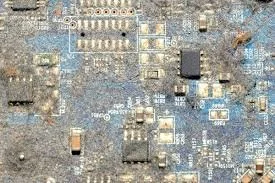
When one of these conductors is completely eroded, malfunctions start to appear on our board. There are two ways to protect boards from this oxidation process:
conformal coating
Resin encapsulation
Conformal coating.
Conformal coating means protecting boards with varnishes that form thin films between 25 and 100 microns thick. The chemical and thermal resistance of conformal coatings is generally good for short exposures. One drawback is that it is difficult to guarantee that the conformal coating has been deposited evenly on all the surfaces to be protected
Resin encapsulation
The resin is applied in a layer several millimetres thick. The greater thickness ensures complete protection of the circuit against all chemical attack, even in the event of prolonged immersion. The resin also provides superior protection against mechanical shock.
The level of protection offered by resin is infinitely better than that of conformal coating; it is used extensively in all IP68 applications, and it is the protection we adopt for our boards.